Three generations of innovation
The technology powering Brombal's Fresh Produce today is built on more than 40 years of trial and error.
Brombal credits much of that work to his grandfather, who introduced hydroponic growing to the farm in 1983.
"He's the man to thank," Brombal said.
Over decades, the family refined everything from growing methods to nutrient formulations for different lettuce and herb varieties. What once involved constant experimentation has evolved into a highly tuned system.
"It's just fine tuning," he said.
While technology has transformed the operation, the workload remains demanding. During summer, the day starts at 3:30am as teams prepare orders before harvesting produce destined for customers the very same day.
The cycle doesn't stop once the lettuce leaves the farm.
"Everything we pick that day gets replanted the same day," Brombal said.
It's a pace that continues seven days a week.
"Not really," Brombal said when asked about days off. "It's a seven day a week operation."
The biggest change from his grandfather's era is the role technology now plays.
"My grandad worked really hard too. Everything was longer days and was hands on," Brombal said. "The technology wasn't there."
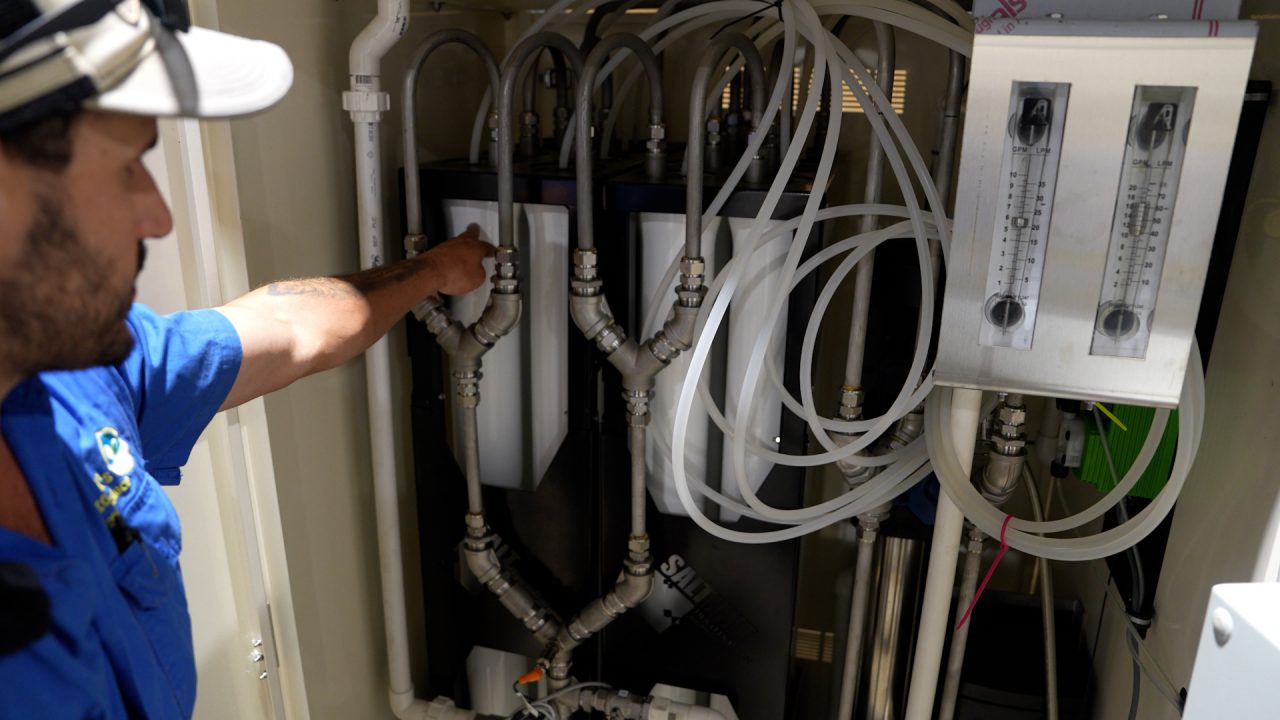
Today, automated monitoring systems track water quality, nutrient levels and infrastructure performance across the farm, allowing the team to focus on improving operations rather than routine checks.
"It takes us away from doing simple checks to things that make the farm better," he said.
Engineering the perfect growing environment
Step inside Brombal's Fresh Produce and it quickly becomes clear this isn't a conventional lettuce farm.
The entire growing operation sits beneath expansive shade-cloth structures that have been designed to filter sunlight, protect crops and create more consistent growing conditions year-round. Combined with hydroponic growing systems, purified water and tailored nutrient programs, the farm has evolved into a highly controlled production environment.
Ask Brombal what surprises visitors most and his answer isn't the desalination technology or the automated monitoring systems.
"I think the way we are so efficient with our growing," he said.
"We don't use as much water as ground. We're so quick at growing them. We use less fertiliser, less water, less human power, less diesel."
Every part of the system has been designed to maximise efficiency, from the way water is recycled through the hydroponic network to the nutrient formulations developed for specific crop varieties.
That focus on continuous improvement remains a key driver for the business.
"We're always thinking about how to do better, how to maybe reuse and what we can do better for the environment too," Brombal said.
The result is a farming operation where technology, data and decades of growing knowledge work together to produce more food using fewer resources.
What comes next?
The Brombal family is already thinking about the next wave of innovation.
While robotics and artificial intelligence are still emerging technologies for many agricultural businesses, Brombal believes they could eventually help farms address labour shortages and improve productivity.
For now, the focus remains on producing high-quality lettuce and herbs while continuing to refine the systems that underpin the farm's success.
The business has recently attracted attention beyond the agricultural sector, featuring in a CHEP sustainability case study, highlighting its transition from single-use packaging to reusable plastic crates to reduce waste and improve supply chain efficiency, appearing on shows such as Farm to Fork and MasterChef.
Yet despite the growing profile, Brombal's Fresh Produce remains, at its core, a family farm that has spent decades adapting, experimenting and investing in new ways to grow food.
The CommBank Tour visited Lismore as part of a national initiative designed to enhance financial fitness in regional Australia and bring communities together. Visit The CommBank Tour to learn more.