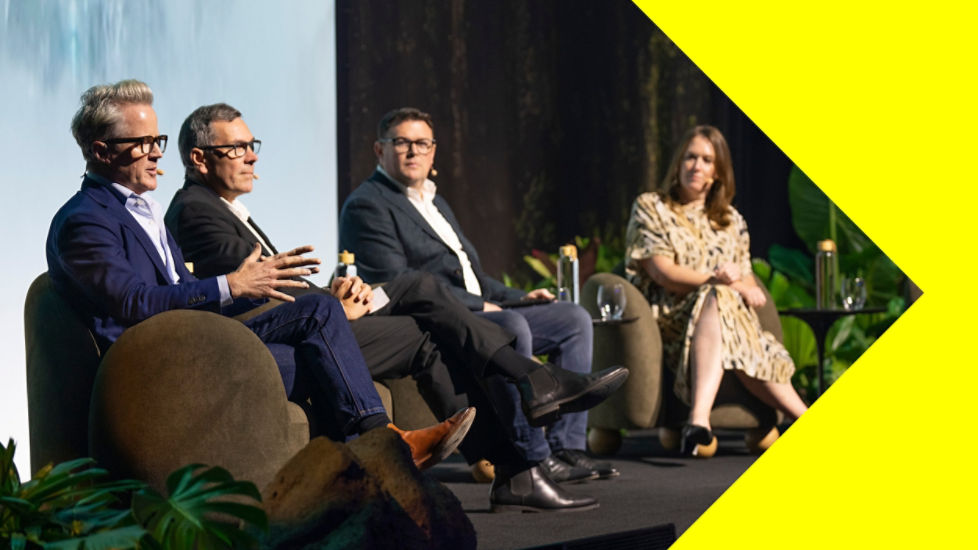
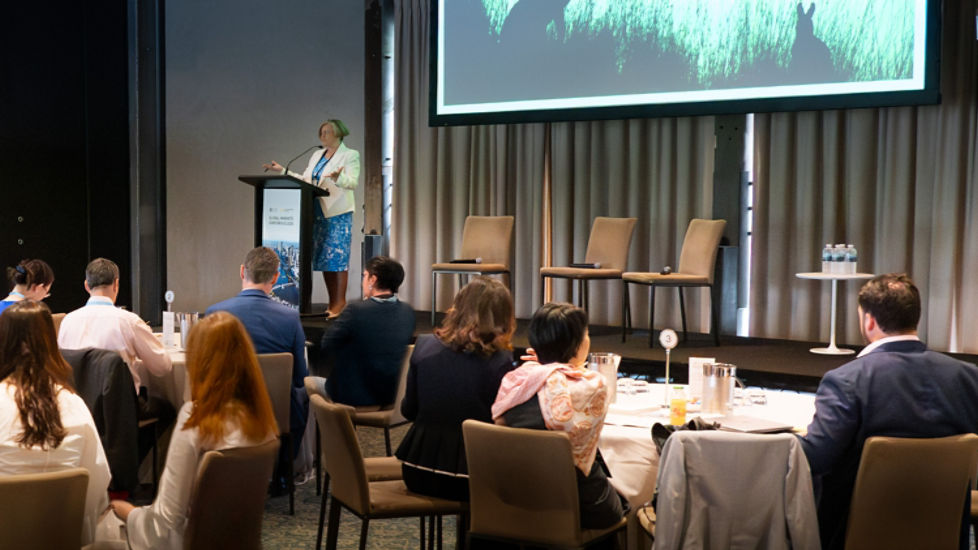
From product-as-a-service models to redesigning materials for reuse, businesses are finding new value in the resources they already have.
Embedding circularity into companies’ business models can help them meet their net zero, nature and sustainability targets.
Circularity is more than just recycling — it touches on the design of a product and its whole lifecycle.
Lisa McLean, Managing Director and CEO, Circular Australia, describes it as decoupling economic growth from the consumption of finite resources.
“It’s based on designing out waste and pollution at every point of the economy — production, use and end-of-life materials,” McLean told the recent CommBank Momentum conference.
Circularity is focused on growth and productivity — extracting the residual value of products and keeping them going in the economy for longer, said McLean.
“It’s about keeping those materials at their highest value for as long as possible in the economy.”
“It’s based on designing out waste and pollution at every point of the economy — production, use and end of life materials. And it’s about keeping those materials at their highest value for as long as possible in the economy.”
— Lisa McLean, Managing Director and CEO, Circular Australia
Achieving net zero targets
“There’s a real incentive that a circular economy can help you meet your targets on net zero and nature, and sustainable development goals and ESG. It is core business, and it will require thinking about your supply chain and looking in there about the residual value of the assets in the waste creation,” said McLean.
Australia won’t be able to achieve net zero carbon emissions without circularity, she said, because of the amount of carbon embedded in buildings and products.
The idea has been embraced by the government, which last year set a target to double Australia’s circularity of the economy by 2035.
The Australian Government has started to incorporate circularity into its procurement, starting with requiring construction suppliers to reduce waste and replace virgin resources with recycled content in projects above $7.5 million.
Additionally, around three-quarters of Australia’s trading partners in the G20 economies are introducing circular economy policies and this will be important in Australia’s current trade deal negotiations with Europe.
“We need to be able to plug in and play with that global market,” McLean told the Momentum conference, adding that if Australia did not act on circularity, the country risked becoming a dumping ground for non-circular products.
Manufacturers will need to take responsibility for their products throughout their lifecycle, which will create products-as-a-service (PaaS) business models, where people rent products, rather than own them and the manufacturer is responsible for repurposing the product at its end of life.
“There’s a real incentive that a circular economy can help you meet your targets on net zero and nature, and Sustainable Development Goals and ESG. It is core business.”
— Lisa McLean, Managing Director and CEO, Circular Australia
Circularity in action
Australian waste and recycling company Cleanaway is working towards a circular economy with a range of recycling initiatives, such as its program to repurpose domestic and commercial food organics and garden organics (FOGO). The company’s FOGO collections divert the waste from landfill and convert it into compost.
“If we can get it off the kitchen table, back into agriculture and back to the kitchen table, we have become circular,” Ash Turner, State Manager Resource Recovery at Cleanaway, told the conference.
Turner said regulation is required to get more companies to take part in repurposing their waste, because it currently costs money to do so.
Sarah Lalor, General Manager ESG and Sustainable Finance at CommBank, said the finance sector will need to lean into lending for circularity initiatives, for Australia to meet its target.
CommBank is a member of Circular Australia’s Finance & Investment Taskforce, which develops and communicates guidance and tools to demonstrate the economic benefits of circularity, helping finance sector participants accelerate the transition from linear to circular practices in lending and investment decisions.
“We know that circular businesses are more profitable,” said McLean. “They create new revenue streams, use less resources and can really derisk investments.”
“If we can get it off the kitchen table, back into agriculture and back to the kitchen table, we have become circular.”
— Ash Turner, State Manager Resource Recovery, Cleanaway