The 37 future skills leaders need to understand in the AI era

Navigating uncertainty to unlock the true value of AI depends on empowering your people, redesigning workflows and building the skills and adaptability to act today rather than waiting for a perfect map of tomorrow.

20 November 2026

  • Leaders must focus on building their employees’ capabilities to navigate an unpredictable AI future, rather than waiting for certainty.
  • Extracting the true value of AI requires organisations to fundamentally redesign workflows and reimagine where the human touch is most powerful.
  • Companies cannot rely on hiring to fill future talent gaps and must instead upskill existing staff to retain essential institutional knowledge.
  • Giving people greater visibility of their skills and future opportunities can help them prepare for change before it becomes urgent – an approach CommBank is putting into practice through Grow Your Career.

AI is redefining what success looks like and 90% of CEOs expect this will matter to their industry in the next two years. That is just one of the findings of The 2027 Skills Horizon1 from Sydney Executive Plus, the University of Sydney Business School’s centre for leadership development and research.

But exactly how AI will reshape work, organisations and the skills people need is still evolving. For leaders, the challenge is how to prepare their organisations and people for what comes next when the path ahead can’t be predicted with certainty.

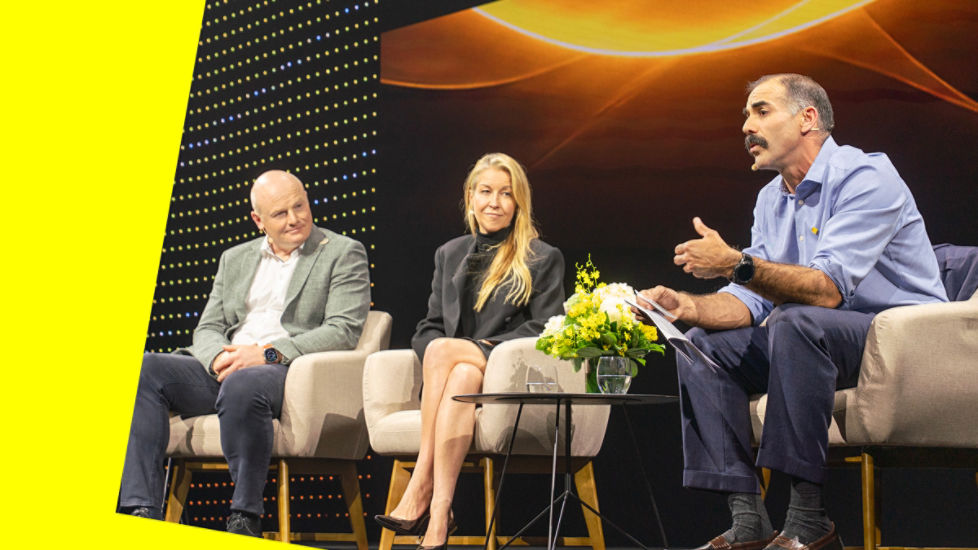
This was a key theme at the second CommBank Accelerate AI Summit in Sydney held on 18 November 2026.

“The pace of change means none of us has the perfect map of the future,” says Kiersten Robinson, CommBank Chief People Officer. “But uncertainty doesn’t mean waiting for certainty.” And the answer starts with people, not technology. 

No reason to wait

That uncertainty is at the heart of the  2027 Skills Horizon. Co-author Dr Sandra Peter told the audience that organisations are effectively operating in an R&D environment, where the pace of change makes it impossible to know exactly what comes next.

Rather than trying to predict the future, the University of Sydney research focuses on what leaders can do to prepare for it.

The 2027 Skills Horizon surfaces 37 skills that leaders will need to navigate in the next three to seven years. These include things already being implemented, including AI fluency, data fluency and cyber resilience.

But it also highlights two skills it calls “unexpected emergers”: play and consequential thinking, which is about considering the knock-on effects of your decisions. Peter says leaders once did this by instinct, but now need to give it their deliberate attention.

“The pace of change means none of us has the perfect map of the future.” – Kiersten Robinson, Chief People Officer, CommBank

So how do you plan and deliver good leadership in a reality where reliably predicting that future has become next to impossible?

Rather than trying to predict every job of the future, Robinson says a more useful question is: How do we help people build the capabilities to navigate what comes next?

Alexis Krivkovich, Senior Partner at McKinsey & Co, says the consultancy’s own research shows 80% of workers believe AI is improving their productivity, but only 6% of organisations say it is fundamentally improving their bottom line. The 2027 Skills Horizon reports research from Deloitte and Boston Consulting Group that only 28% of chief financial officers have seen AI deliver clear, measurable value and only 30% of CEOs say their organisations have put AI agents into real workflows.

What companies at the advanced edge of this are doing is taking core roles and looking at how AI can change the flow of an average workday, rather than leaving the choices about what to automate up to the individual workers. To really unleash potential, Krivkovich says you need to “reimagine the places where human touch is most powerful” and then redesign how you are using AI underneath that.

That’s still a big challenge for most organisations. The 2027 Skills Horizon reports research that finds 84% of companies have yet to redesign jobs around what AI can do today. That goes some way to explain why, even though 42% of regular frontline AI users say they save eight hours a week, 66% also say they receive little guidance on what to do with that time.

Part of the problem is that people are not currently being rewarded for changing how they work. Microsoft found 45% feel safer sticking with how they work now.

“This is also an existential challenge to how we perceive ourselves as leaders at work,” says Peter. “This will change who we are as people. And where our expertise lies and how we personally do our work.”

The enduring value of human skills

Krivkovich says there is a set of enduring skills that have always mattered – things like problem solving, interpersonal skills, collaboration and coordination skills.

But there are also some skills that are gaining value faster than others.

AI is great at pattern recognition, but you still require the human judgement on top, she says, and you also need systems thinking – the ability to understand how the AI and the people can effectively work together.

Human judgement is exactly what is at risk when people hand too much of their thinking over to AI, a habit The 2027 Skills Horizon calls “cognitive offloading”. Research shows using AI in learning environments leads to lower retention and 48% of workers admit handing tasks to AI before trying to solve the problem themselves.

That matters because AI helps people more when they have a greater level of expertise to begin with. Used in ways that wear that expertise down, it becomes less useful.

CommBank is applying this thinking by looking at work through the lens of tasks and skills, helping its people better understand the capabilities they bring today and explore how their work could evolve over time. “We think about jobs as collections of skills and tasks bundled together,” says Stuart Munro, Group Executive, Group Strategy.

That information is made available to employees, through Grow Your Career, CommBank’s AI-powered career platform, where people can explore the skills and experiences they bring, how the work within their role could evolve and capabilities they may want to build for the future. The experience is designed to create curiosity and help people prepare – not predict what will happen to an individual role.

“We think about jobs as collections of skills and tasks bundled together.” - Stuart Munro, Group Executive, Group Strategy, CommBank

Krivkovich recommends a transparent approach. “I think leaders who handle this very well are open to some amount of that vulnerability,” she says. The more open organisations are about what that journey looks like, and the more clearly they show a positive journey ahead, the better in terms of both staff retention and realised gains from AI.

What employees complain about most, Krivkovich says, is that work is slow and complicated because the organisation is split into separate departments. Each has its own processes, approvals and systems, so anything that crosses from one department to another gets bogged down.

She recommends leaders use a cross-silo potential to rethink how work is divided between departments and individuals to reduce cumbersome handovers, rather than keep the old divisions in place.

Prepare and be ready

“Today, 70% of individuals would say they feel personally ready to take on this moment,” says Krivkovich, “which is encouraging, because there’s still a lot of fear and anxiety in the system and [some] stress around what it all means.”

But when you ask those same people whether their organisations are ready to move with them and enable them in adopting effective AI, that number drops to 27%.

Krivkovich says a majority of leaders will admit that their organisations are not really rethinking their operating models yet. And the first step in properly tackling that challenge is taking apart your workflows and identifying the fundamental principles of good governance, accountability and risk management. “But you want to take smart risks,” she says.

The 2027 Skills Horizon reports 74% of companies plan to deploy AI agents, but only 21% have a mature method of overseeing them.

“I’d say the vast majority of companies I talk to would give themselves pretty low marks on their maturity of having thought that through in this moment and they see it as a huge need looking ahead,” Krivkovich says.

Munro says the shift requires significant coordination across organisations. . “There’s a huge amount of coordination required to keep everything aligned,” he says, adding that the swelling demand for coordination has resulted in an equally enormous number of meetings to get decision-makers on the same page, which is exactly the kind of work that is prime for automation.

And the data backs that up. “The roles that have grown the fastest are not tech and engineering roles,” Krivkovich says. “They’re not product roles. They’re not even back office roles.” They are in the coordination roles that connect all the other functions together. “That’s something AI can do incredibly well,” she says.

Taking that coordination work off people’s plates can’t come soon enough for many. The 2027 Skills Horizon reports 75% of middle managers have signs of overwhelm severe enough to affect how they manage their teams. Managers spend only 41% of their time actually managing people, it reports, with the rest taken up by the systems around them. And poorly deployed AI is contributing to that overwhelm: 50% of leaders say they now spend more time reviewing and correcting AI output.

This is a concern, given that Peter says leaders need to be involved and maintain a sense of curiosity.

“You will need to get your hands dirty,” says Peter. “That means hands on the tools. Because work is changing, and you need to be involved.

“My contention to you is that you need to start to play,” she says. “This is something that teams can do together to explore new ideas, to find out new things, to learn new things together. This is what makes uncertainty feel a lot less daunting.”

Connect with purpose

That pressure puts the next generation of leaders at risk, too.

The 2027 Skills Horizon reports that 40% of middle managers have considered leaving their roles and 80% of HR leaders lack confidence in their leadership pipelines. “Our middle managers in our organisations are the ones who bear the brunt of figuring out how to do this in practice and how to implement all the change that we’re seeing around us,” says Peter. “So pay attention to your middle managers. Make sure they don’t burn out.” 

Leaders “have to lighten the load on middle managers, but also connect leadership to purpose”, Peter says.

Krivkovich says companies will not be able to hire their way out as there are not enough people in the job market who already have the skills they’ll need, and replacing a whole workforce isn’t realistic. 

“You won’t be able to go out into the job market and suddenly find a large swathe of people who already have all the skills in the future that you want,” she says. Existing staff also hold institutional knowledge that businesses need to hold onto tightly right now.

Used well, AI can multiply what one person can achieve and it’s helpful to shift your mindset from one centred on what AI is taking away from your sense of identity towards how it can make you even better at what you do. Munro gives the example of a “brilliant coder” who instead of being limited by the hours in their day could lead a team of “the best coders in the world, they just happen to be agentic – and what we can do together is phenomenal”.

Krivkovich says leaders can rethink speed as a strategy in and of itself and understand that waiting for perfect clarity before you make your move is a path to failure. “This is the moment of building the muscle and getting your organisation ready for a future state with a lot of ambiguity in front of you,” she says. “There's no wrong move, just as long as you start getting in motion.”

It brings the conversation back to Robinson’s challenge: leaders may not have a perfect map of the future, but they can help people prepare – with greater visibility of what could be possible, the curiosity to keep learning and the confidence to navigate what comes next.

Spark brighter ideas

Get the latest research, actionable insights and expert views on the big issues facing businesses.

Things you should know

  • 1The 2027 Skills Horizon

    This article is intended to provide general information of an educational nature only. It does not have regard to the financial situation or needs of any reader and must not be relied upon as financial product advice. You should consider seeking independent financial advice before making any decision based on this information. The information in this article and any opinions, conclusions or recommendations are reasonably held or made, based on the information available at the time of its publication, but no representation or warranty, either expressed or implied, is made or provided as to the accuracy, reliability or completeness of any statement made in this article.

    Credit provided by the Commonwealth Bank of Australia. This product is only available to approved business customers and for business purposes only. Applications for finance are subject to the Bank’s eligibility and suitability criteria and normal credit approval processes. Rates, fees and Terms & Conditions apply.