Markets eye Iran talks, jobs data and US inflation

Financial markets faced a week driven by developments in the Middle East, fresh labour market data in Australia and a closely watched US inflation reading.

26 June 2026

Ships in the Strait of Hormuz

Key Points

  • Markets continue to react to developments in the US-Iran conflict 
  • Oil price swings tied to Strait of Hormuz risks and peace talks 
  • Australia’s labour force data in focus after recent volatility 
  • US inflation data to guide Federal Reserve outlook 

Iran conflict keeps driving markets

Markets continue to trade on headlines tied to the US-Iran conflict, with oil prices reacting quickly to developments around the Strait of Hormuz and peace talks.

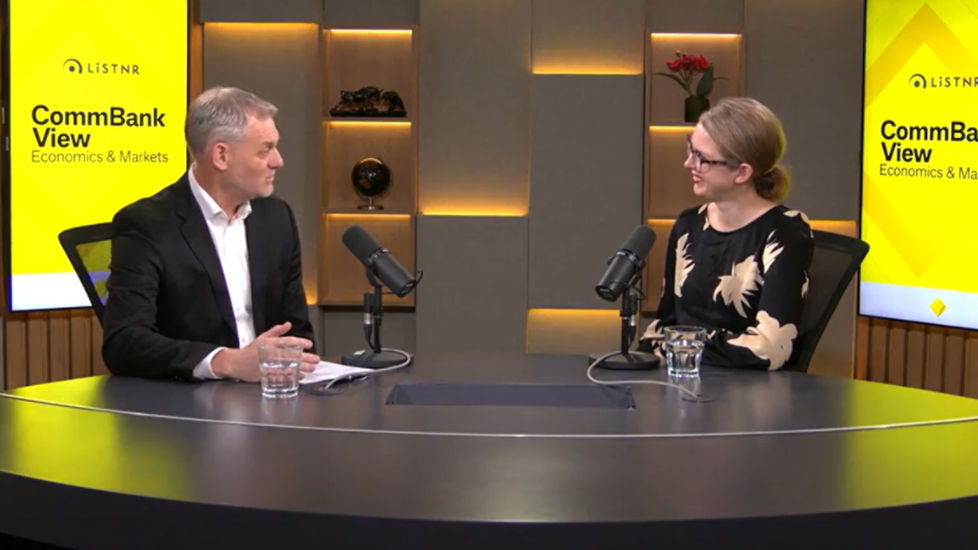
Speaking on Thursday’s CommBank View: Economics & Markets podcast episode, CommBank Economist and Currency Strategist Carol Kong said that was evident earlier in the week, when oil prices initially jumped on concerns Iran could again close the key shipping route.

“We saw oil prices initially jump on the back of news that Iran could potentially close the Strait of Hormuz again, and President Trump threatened military action against Iran,” she said. “However, we saw oil prices quickly reverse course after peace talks in Switzerland proceeded as expected.” 

Kong said there were signs of progress, but cautioned the situation remained fragile.

“It is positive that the two warring sides continue to talk, but the weekend events do suggest that the ceasefire is still at risk of collapsing.”

Despite the volatility in oil, she said financial markets had become less sensitive to price swings than earlier in the conflict.

Australian jobs data in focus 

On Thursday, attention turned to the latest labour force report.

Australia's unemployment rate fell to 4.4% in May as employment rebounded by 40,300 jobs, although Commonwealth Bank economists say the broader trend points to a gradual easing in labour market conditions.

"The labour market remains a little tight but is slowly loosening broadly in line with our expectations," CBA Economist Harry Ottley said. While the monthly unemployment rate dipped from 4.5%, the trend measure edged up to 4.4%, reflecting a gradual softening in labour market conditions.

US inflation to guide markets 

Attention shifted to US inflation figures later on Thursday, with the Personal Consumption Expenditures Price Index, the Fed's preferred inflation gauge, rising at a seasonally adjusted 4.1% annual rate in May.  

Kong said the release was always closely watched by markets and had taken on greater importance because of new Fed Chair Kevin Warsh's strong commitment to price stability.  

CommBank View: Economics & Markets

The week ahead is part of the podcast, CommBank View: Economics & Markets.

Listen via major podcast platforms:

Apple          |        LiSTNR       |      Spotify

Newsroom

For the latest news and announcements from Commonwealth Bank.

Things you should know

The information presented is an extract of a Global Economic and Markets Research (GEMR) Economic Insights report. GEMR is a business unit of the Commonwealth Bank of Australia ABN 48 123 123 124 AFSL 234945.  

This extract provides only a summary of the named report. Please use the link provided to access the full report, and view all relevant disclosures, analyst certifications and the independence statement.    
   
The named report is not investment research and nor does it purport to make any recommendations. Rather, the named report is for informational purposes only and is not to be relied upon for any investment purposes.    
   
This extract has been prepared without taking into account your objectives, financial situation (including your capacity to bear loss), knowledge, experience or needs. It is not to be construed as an act of solicitation, or an offer to buy or sell any financial products, or as a recommendation and/or investment advice. You should not act on the information contained in this extract or named report. To the extent that you choose to make any investment decision after reading this extract and/or named report you should not rely on it but consider its appropriateness and suitability to your own objectives, financial situation and needs, and, if appropriate, seek professional or independent financial advice, including tax and legal advice.