Housing, AI and geopolitics define the economic outlook

CommBank economists say the slowdown in Australia’s economy is now more likely to be driven by housing prices than oil shocks, amid a global economy that’s being redefined by AI, energy prices and shifting geopolitical risks.

9 July 2026

A person walks past an auction sign outside a property in Sydney, Australia, June 22, 2026. REUTERS/Hollie Adams

Key points

  • Australia's economic growth is expected to slow as a lower house price growth weighs on consumer spending and broader economic activity.
  • AI investment is emerging as a significant growth driver in the US and east Asia. Australia is benefiting from a large data centre pipeline.
  • The global economy is benefiting from lower oil prices, but geopolitical tensions and trade dynamics continue to create risks and opportunities.

Housing becomes the central challenge for Australia

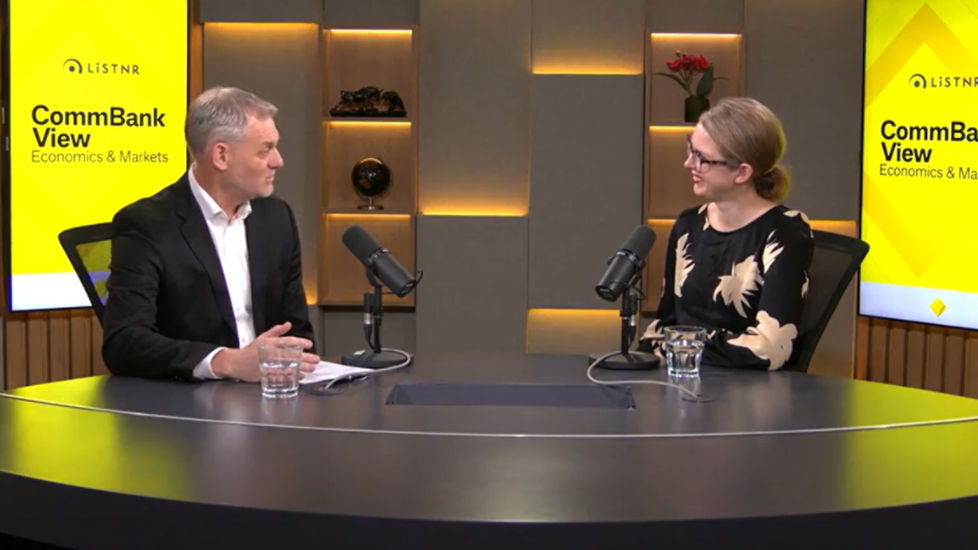
The shape of Australia’s slowdown has changed over recent months, with housing now expected to be a bigger drag than energy prices, CommBank Head of Australian Economics Belinda Allen says.

“We’ve certainly seen a shift in what’s going to cause the Australian economy to slow,” Allen said. “We still think that’s going to happen, but it’s really the housing market that’s going to create that slowdown in the Australian economy, rather than higher oil prices.”

The slowdown in home price growth that emerged in late 2025 has now spread across Australia’s housing market, with weaker conditions for sellers evident in most major capitals. Allen said higher interest rates and policy changes had weighed on sentiment and prices. 

“That combination of factors has seen the housing market pull back, and we’ve seen in past cycles that does impact the consumer through what economists call the wealth effect,” she said.

Falling home values typically make households feel less financially secure, encouraging them to save more and spend less. Allen said that dynamic was now expected to be a key drag on economic growth throughout 2026.

Commonwealth Bank forecasts growth in Australia’s economy will slow from 2.5% in late 2025 to 1.5% by late 2026, before improving to about 2% by late 2027.

Consumer spending also slowing 

Consumer spending is also showing signs of moderation. Allen said CBA’s internal data suggested end-of-financial-year sales activity had softened compared with the same period last year.

“There are signs that consumers are pulling back,” she said.

While household savings remain relatively healthy overall, Allen said weak sentiment and softer home prices were likely to keep consumers cautious through the remainder of the year.

At the same time, unemployment rates are expected to rise. CBA has lifted its peak unemployment rate forecast to 4.8%, with Allen noting the Reserve Bank of Australia will be watching employment conditions closely as it balances inflation and growth. 

Where to listen

CommBank View: Economics & Markets is available across major podcast platforms.

Apple   |    LiSTNR     |   Spotify    |   YouTube

New growth opportunities in Australia

Despite the housing-led slowdown, Allen said data centre development to fuel AI compute investment were creating important longer-term opportunities for the Australian economy.

“We do think that’s going to boost growth over the next few years,” she said. 

Australia’s data centre pipeline continues to expand as global technology companies lift investment in infrastructure to support AI. But Allen cautioned that growth would be constrained by energy availability, water use and the time required to build new facilities. A large amount of the data centre investment, particularly the compute is imported and will dilute the impact on the Australian economy.

“So while we’re optimistic, we do think there’ll be constraints for the data centre build-out,” she said. “It will help Australia’s economy, but it’s not going to fully make up for that slowdown in the consumer [sector].”

Global growth recovers as energy risks ease

At a global level, lower oil prices and a surge in artificial intelligence investment had improved the outlook, but trade and geopolitical risks remained significant, CommBank’s, Head of FX, International and Geoeconomics, Joe Capurso said. 

The rapid fall in oil prices following the memorandum of understanding between the US and Iran had reduced one of the major risks to growth, Capurso said.

“The collapse in oil prices was really unexpected,” he said. 

“We thought oil prices would stay elevated for longer, but they’ve come back down to pre-war levels very fast.”

CBA forecasts the global economy will grow by 2.5% in 2026 before accelerating to 2.7% in 2027. While growth risks have faded, higher gas prices remain a challenge for parts of Europe following damage to Qatari gas infrastructure.

AI boom moves beyond tech

Capurso said one of the most important developments in the global economy was the scale of AI-related investment in the US.

“It is extraordinarily large,” he said. “It’s so big that it is moving the dial on the US economy.”

CBA estimates the five major hyperscalers will spend just under $US800 billion this year, around 80 to 85% more than last year, before lifting spending to almost $US1 trillion next year. 

According to CBA research, the surge in AI investment is expected to add around half a percentage point to US economic growth in 2026. It will also create significant spillover benefits for economies across east Asia and North America that supply equipment and components to the AI industry.

“Smaller economies like Mexico, Vietnam, Malaysia, Korea and Taiwan are major beneficiaries of this US AI capital spending,” Capurso said. “But even the big economies like Japan and China are going to be beneficiaries as well.”

China is also expected to benefit from strong exports linked to AI and green technology such as electric cars, even though domestic demand remains weak.

“The other thing that hasn’t changed in China is that it’s still a two-speed economy,” Capurso said. “Exports of AI, high-tech and green technology are very strong, and are really pulling the Chinese economy along. But the consumer side remains very weak.” 

For Australia, the overall result is a split outlook. We face a housing-led slowdown as consumers become more cautious at the same time the global economy is receiving a powerful boost from AI investment and lower oil prices. But CBA’s economists warned the benefits of the improved global conditions would be shared unevenly, with Europe constrained by gas prices and China still reliant on exports while domestic demand remains weak.

Newsroom

For the latest news and announcements from Commonwealth Bank.

Things you should know

The information presented is an extract of a Global Economic and Markets Research (GEMR) Economic Insights report. GEMR is a business unit of the Commonwealth Bank of Australia ABN 48 123 123 124 AFSL 234945.

This extract provides only a summary of the named report. Please use the link provided to access the full report, and view all relevant disclosures, analyst certifications and the independence statement.

The named report is not investment research and nor does it purport to make any recommendations. Rather, the named report is for informational purposes only and is not to be relied upon for any investment purposes.

This extract has been prepared without taking into account your objectives, financial situation (including your capacity to bear loss), knowledge, experience or needs. It is not to be construed as an act of solicitation, or an offer to buy or sell any financial products, or as a recommendation and/or investment advice. You should not act on the information contained in this extract or named report. To the extent that you choose to make any investment decision after reading this extract and/or named report you should not rely on it but consider its appropriateness and suitability to your own objectives, financial situation and needs, and, if appropriate, seek professional or independent financial advice, including tax and legal advice.