1. The 'peace dividend' is over
After decades in which Australia and other Western countries were able to keep defence spending relatively low, the global picture has changed. Military spending is rising around the world as governments respond to war in Ukraine, conflict in the Middle East, tensions in the Indo-Pacific and a more uncertain strategic environment.
Global military expenditure reached a record US$2.887 trillion in 2025, marking the eleventh straight year of growth.
2. Australia is unlikely to be an exception
Australia’s defence spending has generally fallen as a share of the economy since the Korean War, when it reached 5.2% of GDP. It hit a low of 1.6% in 2013 and was around 2.0% in 2025.
That period of relatively restrained spending is now giving way to a much larger defence investment cycle, driven by the need to modernise the Australian Defence Force and build more domestic defence capability.
3. Old assumptions no longer hold
For decades, Australia’s defence strategy rested on several assumptions: that the country would have significant warning time before a major conflict, that the US alliance would remain the ultimate security backstop, and that Australia’s main task was to defend the continent and its approaches rather than project power far from home.
Those assumptions are being reconsidered as China expands its military capability, Russia’s war in Ukraine continues, sea lanes become more vulnerable, and the US asks allies to take greater responsibility for their own regional security.
4. The new strategy is about denial, resilience and local capability
Australia’s new defence strategy is built around a “Strategy of Denial” — the idea that Australia must be able to deter or prevent a potential adversary from projecting power against Australia or through the region.
That means more domestic sovereign investment in long-range strike, submarines, missile defence, drones, cyber, munitions, maritime capability and supply-chain resilience. It also means building more capability at home, rather than relying heavily on overseas suppliers during a crisis.
5. The official spending plan is already very large
The 2026 National Defence Strategy projects around $887 billion in defence funding over the next decade, including $425 billion for capability investment.
Budget papers show total defence funding, including cyber and intelligence, rising from $63.4 billion in 2026-27 to $106.7 billion in 2033-34 and $112.1 billion in 2035-36.
6. AUKUS is the biggest driver of the investment boom
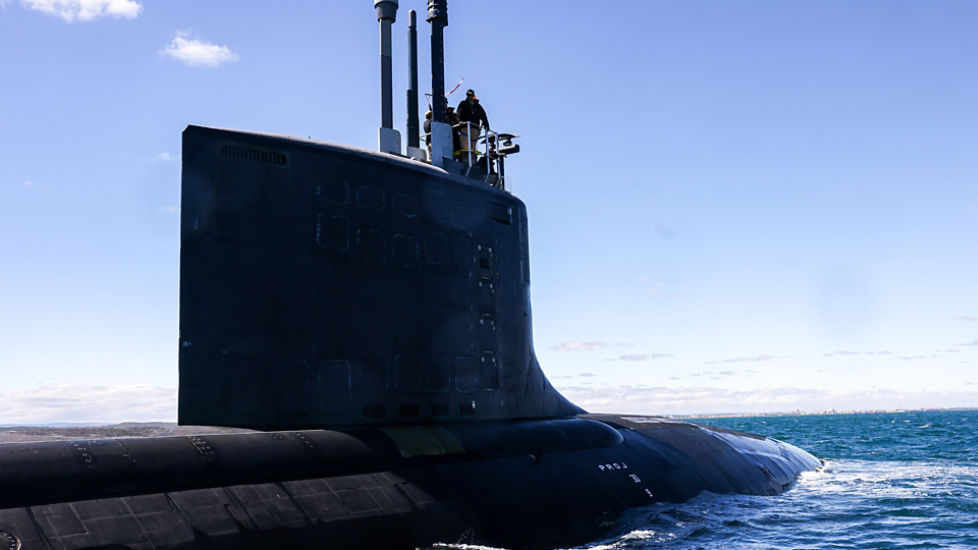
AUKUS - the trilateral security partnership between Australia, the UK and the US - is now the dominant force shaping Australia’s defence spending outlook.
The federal government estimates the AUKUS submarine program will cost $268 billion to $368 billion over 30 years, making it the largest defence acquisition project in Australian history. Spending is expected to rise through infrastructure work, nuclear workforce development, Virginia-class submarine purchases and, later, the development of the SSN-AUKUS submarine fleet.
7. AUKUS will put pressure on the rest of the defence budget
The first decade of AUKUS spending is expected to be funded within the government’s existing $887 billion defence profile, including $425 billion of spending on military capabilities over the next decade.
CBA Economics estimates AUKUS submarine spending over the next decade at around $71 billion to $96 billion, equal to 8-11% of total defence spending if the $887 billion profile holds. This is in addition to the other existing priorities, especially as Australia also needs to invest in drones, missiles, cyber, air defence and long-range strike.
8. Defence spending may need to go higher than official projections
The government has shifted to a NATO-style measure of defence spending, under which spending is expected to rise from 2.8% of GDP today to 3.0% by 2033-34. On CBA Economics’ calculations, that equates to about 2.5% of GDP under the traditional measure.
Because of these competing capability investment priorities, CBA Economics forecasts defence spending will ultimately need to reach at least 3.0% of GDP on the traditional measure by the mid-2030s. That would imply about $1.024 trillion in defence spending over the decade — around $137 billion more than the government’s current Budget and National Defence Strategy profile.
9. Defence policy is shifting from 'buying oversea's to 'making in Australia'
The next phase of defence investment is not just about buying more military equipment. It is also about building a larger sovereign defence industrial base.
That does not mean Australia will build every major platform from scratch. It means Australia wants more capacity to design, manufacture, sustain, repair and replenish critical capabilities locally, especially in areas such as guided weapons, munitions, drones, counter-drone systems, defence electronics, software, AI, cyber, sustainment and naval shipbuilding.
10. The economic benefits will spread beyond traditional defence suppliers
Australia’s defence industry contributed $12 billion in gross value added in 2024-25, equal to almost 0.5% of the economy. The largest direct beneficiaries were professional, scientific and technical services, manufacturing and construction.
The next phase of investment is expected to broaden the opportunity to advanced manufacturing, engineering, technology, telecommunications, digital services, cyber and smaller defence suppliers.
South Australia and Western Australia are best placed to benefit from AUKUS, naval shipbuilding and maritime capability, while New South Wales and Victoria are expected to gain from advanced manufacturing, aerospace, defence technology and research.
This explainer is a summary of Ryan Felsman’s CommBank Business and Industry Insights report, “Australia’s defence investment boom”, published on 7 July 2026.