CommBank economists stick with November RBA interest rates call, but outlook remains uncertain

Commonwealth Bank economists still expect the RBA to hold the cash rate at 4.60% in November, but say the risk of further increases is building.

19 October 2026

Reserve Bank board members appear at a House Committee at Parliament House in Canberra. Picture: AAP

Key points

  • CommBank still expects rates to stay on hold in November.
  • Further increases are becoming a bigger risk.
  • Separate CommBank data shows household spending growth is slowing.

Commonwealth Bank’s economics team is sticking with its forecast that the Reserve Bank of Australia (RBA) will leave interest rates unchanged in November, but CBA Chief Economist Luke Yeaman says the risks of further increases are building.

Yeaman's central case is that four rate rises this year will continue to slow economic activity, giving the RBA time to assess how much more work is needed to bring inflation back to target.

Yeaman said there were two ways to read the economy at present.

“The cyclical view says the job is almost done; growth is slowing, house prices are falling, consumers are under pressure, unemployment is rising, and a fourth rate hike (and lags) will do the rest.

“The structural view says low productivity, high public spending, the Al capex boom and a rising neutral rate mean policy is not yet restrictive enough, inflation will be persistent and the RBA will have to inflict more pain on households.

"Our base case: the cycle wins, just," Yeaman said in a new economic update.

CommBank expects September-quarter trimmed mean inflation to come in at 1.0%. If that forecast is broadly right and the economy continues to slow, Yeaman said he expected the RBA to keep rates on hold in November and reassess the outlook as more data arrives.

Investments with foreign currency exposure.

Why CommBank still expects a hold

There were already signs tighter monetary policy is weighing on the economy, Yeaman said.

Growth has slowed, house prices are falling and unemployment has risen to 4.7%, from a recent low of 3.4%.

Yeaman also said the full effect of higher interest rates would take time to reach the economy and labour market, with lags of around 12 to 18 months, meaning the impact of this year's four rate increases has not yet been fully felt.

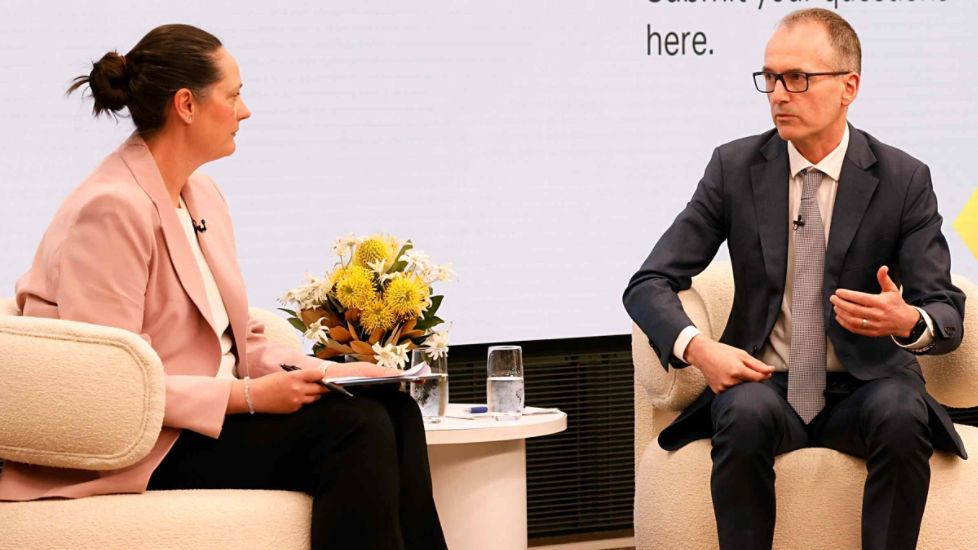
RBA Assistant Governor Christopher Kent made a similar point in a discussion with CommBank Head of Australian Economics Belinda Allen at the bank's Global Markets Conference on Monday.

"We know monetary policy operates with long and variable lags," Kent said.

The RBA's next monetary policy decision is due on 3 November.

Rate rise risk is building

While November remains a hold in CommBank's central forecast, Yeaman said the outlook beyond that had become more uncertain due to the continuing pressure on inflation.

"The 'last mile' on inflation is proving difficult," he said.

Trimmed mean inflation remains around 3.5%, and a range of longer-term forces could make inflation harder to bring down than in previous cycles, Yeaman said, pointing to weak productivity, high public demand and strong investment in areas including AI, data centres, energy, defence, transport and housing.

That investment could ultimately lift Australia's productive capacity. But in the shorter term, it is also adding demand for workers, construction, electricity and technology.

‘Neutral rate’ could be rising

Yeaman also says the neutral interest rate - an estimate of the cash rate that neither speeds up nor slows down the economy - may have risen.

CommBank's real-time estimate of the neutral rate has increased to about 3.85%, around 0.65 percentage points higher than a year ago, Yeaman said.

If neutral is higher, today's 4.60% cash rate may not be restraining the economy by as much as the headline number suggests.

The RBA’s Kent said there was no single measure that could tell the RBA exactly how tight financial conditions were.

Neutral-rate estimates were a useful starting point, but remained highly uncertain, he said.

Household spending slows

Yeaman’s outlook came as new CommBank data showed household spending has slowed during 2026.

Senior Economist Ashwin Clarke said spending growth to early October remained below the stronger rates recorded in late 2025 and early 2026.

The slowdown has paused somewhat in recent months, with spending remaining resilient despite higher interest rates and fuel prices. CommBank still expects further weakness as pressure on household incomes flows through.

The pullback is also uneven.

Spending on eating and drinking out remains resilient, and retail spending, including clothing and electronics, has broadly tracked last year's levels.

But clearer signs of weakness are emerging in housing-related spending. Storage and removalist spending is running below 2025 levels, with housing turnover now around 20% to 30% lower than a year ago. Spending on home improvements and maintenance has also started to soften, the data shows.

Newsroom

For the latest news and announcements from Commonwealth Bank.

Things you should know

The information presented is an extract of a Global Economic and Markets Research (GEMR) Economic Insights report. GEMR is a business unit of the Commonwealth Bank of Australia ABN 48 123 123 124 AFSL 234945.

This extract provides only a summary of the named report. Please use the link provided to access the full report, and view all relevant disclosures, analyst certifications and the independence statement.

The named report is not investment research and nor does it purport to make any recommendations. Rather, the named report is for informational purposes only and is not to be relied upon for any investment purposes. 

This extract has been prepared without taking into account your objectives, financial situation (including your capacity to bear loss), knowledge, experience or needs. It is not to be construed as an act of solicitation, or an offer to buy or sell any financial products, or as a recommendation and/or investment advice. You should not act on the information contained in this extract or named report. To the extent that you choose to make any investment decision after reading this extract and/or named report you should not rely on it but consider its appropriateness and suitability to your own objectives, financial situation and needs, and, if appropriate, seek professional or independent financial advice, including tax and legal advice.