Why AI adoption alone won’t solve Australia’s productivity problem

Global and local leaders in business, economics, government and academia came together at CommBank’s Accelerate AI conference to outline what it will take to turn AI adoption into real change for businesses and the economy.

19 November 2026

Key points

  • Productivity gains will come from redesigning how work is done, not just speeding up existing tasks.
  • AI agents will require new controls, skills and leadership approaches.
  • Businesses are weighing where AI can deliver the greatest long-term value.

How can businesses turn the promise of AI into real productivity gains?

That question was at the heart of Commonwealth Bank’ s second Accelerate AI conference, which brought together more than 1,000 business leaders to discuss Australia's next steps on AI.

Speakers included the CEOs of Wesfarmers, Telstra, Origin Energy, Myer, e61 Institute and Productivity Commission Chair Danielle Wood, University of Sydney’s Dr Sandra Peter and senior CommBank executives.

Here are 10 key takeaways.

1. The biggest AI gains will come from changing how we work

AI adoption has surged, but productivity gains have yet to follow.

A year ago, a third of Australian firms in a Reserve Bank survey weren't using AI. Now almost all do. Meanwhile, output per hour worked has fallen, Commonwealth Bank strategy head Helen Mayhew said.

Most people worldwide use AI for side tasks such as meeting minutes rather than core work, said Danielle Wood, chair of the Productivity Commission. She said firms often experiment before a technology fundamentally changes how they work, meaning productivity can dip before climbing in a J shape.

“I think we're at the bottom of the J at the moment,” she said.

e61 Institute CEO Michael Brennan pointed to electricity as a comparison. US factories had electric motors from the 1880s, but simply replacing steam engines brought only marginal improvements. The bigger productivity gains came in the 1920s, when factories totally redesigned their production lines using electricity.

He expects AI's gains to come when “entire business models are re-engineered”.

2. AI at scale needs a new operating model

AI capability is improving much faster than organisations are changing, said CommBank Group Executive, Strategy Stuart Munro.

While experimenting with AI can be relatively easy, scaling it across a business is much harder.

“Our view is that it's not just about the technology. It's actually about organisations and organisational change,” Munro said.

McKinsey's Alexis Krivkovich said 80% of people in organisations report personal productivity gains from AI, but only 6% of companies say it is fundamentally changing their bottom line through productivity or growth.

Closing that gap means rethinking talent, organisational structures and how work gets done, she said.

Munro said even the “cascade of meetings” traditionally used to coordinate large organisations contains tasks that can be done by agents and “swarms of agents”, helping information flow and decisions happen faster.

3. Own your own knowledge

As businesses gain access to similar AI models, their own knowledge and context could become an increasingly important source of competitive advantage.

CommBank Chief AI Officer Ranil Boteju said continuously improving using an organisation's own context and knowledge, over and above the models it uses, was a way to preserve that differentiation.

“Our context, our knowledge, our processes, all of the insight that sits in our people's heads – that's really the thing that really differentiates us,” Boteju said.

CommBank CEO Matt Comyn said businesses should understand where their intellectual property sits, how they keep it out of external models and how they maintain flexibility between different model providers.

Commonwealth Bank Chief Security Officer Nicola Nicol and Telstra Global Chief Information Security Officer Narelle Devine discuss AI and cyber resilience at CommBank Accelerate AI in Sydney. Photo: Nic Long. Commonwealth Bank Chief Security Officer Nicola Nicol and Telstra Global Chief Information Security Officer Narelle Devine discuss AI and cyber resilience at CommBank Accelerate AI in Sydney. Photo: Nic Long.

4. The workforce of tomorrow needs new skills today

As AI changes the nature of work, businesses will need to invest in helping their people develop new skills and adapt to changing roles.

CommBank Chief People Officer Kiersten Robinson said: “Rather than trying to predict every job of the future, a more useful question is how do we help people build the capabilities to navigate what comes next?”

Krivkovich, who co-leads the global people practice at McKinsey, said organisations cannot expect to find all the skills they need simply by hiring new people.

“You won’t be able to go out into the job market and suddenly find … a large swath of people who already have all the skills of the future that you would want,” she said.

McKinsey has seen demand for AI fluency, or skill with AI tools, rise 11-fold. Krivkovich said that capability will be needed across the workforce, not just among technical experts.

CommBank has used AI to break all 50,000 roles into tasks and skills, said Munro. People can see which tasks may become less relevant and how to build new skills.

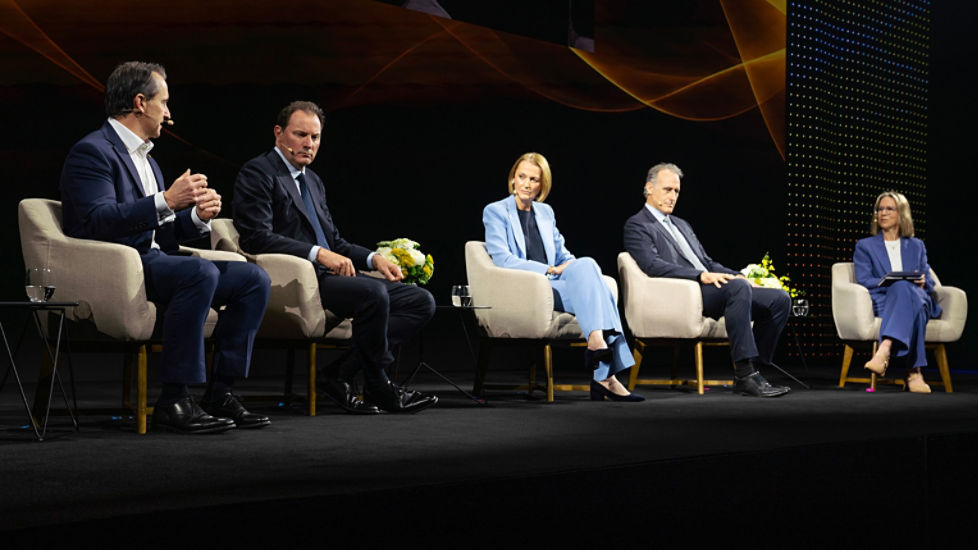
(Left to right) Commonwealth Bank CEO Matt Comyn, Origin Energy CEO Frank Calabria, Telstra CEO Vicki Brady and  Wesfarmers CEO Rob Scott join moderator Jeni Whalan for the CEO panel at CommBank Accelerate AI in Sydney. Picture: Nic Long. (Left to right) Commonwealth Bank CEO Matt Comyn, Origin Energy CEO Frank Calabria, Telstra CEO Vicki Brady and Wesfarmers CEO Rob Scott join moderator Jeni Whalan for the CEO panel at CommBank Accelerate AI in Sydney. Picture: Nic Long.

5. Don't let AI break the career ladder

If AI changes or takes over some of the tasks traditionally done by junior employees, how will they build the experience and judgement they need to progress?

“This is the single biggest thing that keeps me up at night,” Krivkovich said.

 Krivkovich warned that cutting off entry level positions was “the worst solution”, because those firms will have nobody ready to step up in five or 10 years.

The organisations that solve the problem will be the next generation of high performers.

Krivkovich said firms that train junior employees well mix new starters with people who have decades of experience. At one large Silicon Valley technology company, mentoring runs in both directions.

Senior coders teach the judgement they have built over decades. Junior employees show senior colleagues how to experiment with new tools.

6. Leaders must be willing to learn alongside their people

Business leaders need to guide their people through rapid change, even when the path forward remains unclear.

“We’re all in R&D, and none of us know exactly where we are heading,” said Associate Professor Sandra Peter of the University of Sydney.

Leaders need to assess AI's output and use the tools themselves, or as Peter put it, “get your hands dirty”,, to help redesign how work is done.

The change can also be deeply personal. Munro said people who see themselves as “a brilliant coder” may feel “a sense of loss before the gain”.

For experienced leaders, adapting takes “a tonne of humility”, said McKinsey's Krivkovich. After decades rising to the top, they can find themselves “needing to sort of begin again”.

Krivkovich said employees are keenest to embrace AI when leaders are out in front, sharing “their own stories of success and failure”.

7. Know what your AI agents are doing

As businesses deploy more AI agents, they need clear visibility over what those agents are doing and strong controls around what they are allowed to do.

Boteju said CommBank starts by registering every AI agent and AI use case, giving the bank “an incredibly clear line of sight” across its AI capabilities.

Agents are evaluated before deployment and while operating, with runtime guardrails and other checks feeding information back into a central AI control plane.

Comyn said organisations also need to think carefully about access, authorisation, the activities agents are allowed to complete and how they are monitored.

Delegated agents should not operate on an “unconstrained basis”,  he said.

8. Cyber resilience means knowing what you can switch off

AI can now find small software flaws and chain them into an attack. Flaws that look minor today may prove “absolutely devastating” tomorrow, said Narelle Devine, Telstra's Global Chief Information Security Officer.

Boards used to ask whether they were secure, she said. Now they ask: “Is the business still able to operate while you contain that event?”

Firms need to know “what can you turn off that doesn't stop other bits working,” she said, and rehearse those decisions with business teams as well as technology teams.

CommBank Chief Security Officer Nicola Nicol said the bank has mapped its critical services and the technology and suppliers behind each. The map shows the “downstream impact” of taking a service offline.

AI can now help firms understand their networks in a way “we’ve really struggled to do in the past,” Devine said.

CommBank Chief Economist Luke Yeaman, Productivity Commission Chair Danielle Wood, e61 Institute CEO Michael Brennan and moderator Helen Mayhew discuss Australia’s AI productivity challenge at CommBank Accelerate AI in Sydney. Picture: Nic Long. CommBank Chief Economist Luke Yeaman, Productivity Commission Chair Danielle Wood, e61 Institute CEO Michael Brennan and moderator Helen Mayhew discuss Australia’s AI productivity challenge at CommBank Accelerate AI in Sydney. Picture: Nic Long.

9. Smart AI investment starts with knowing where to focus

AI providers charge by the token, giving organisations a clearer view of what AI really costs.

Boteju said he was “quite pleased about the direction that token costs have taken” because “it means we need to be much more disciplined about where we focus our efforts”.

Boteju backs AI where the benefit to the bank and its customers will last.

Fraud and scams come first. The bank’s AI raises millions of fraud alerts and cuts false alarms, while AI agents also keep fraudsters busy.

“They are typically things that we can just never scale humans to do,” he said.

His second priority is building and releasing products faster. CommBank first used AI to write software and now uses it across product development.

Comyn said the bank made 64% more software changes over two years, while incidents fell by about 45%.

10. AI shopping agents could change customer loyalty

Agentic shopping, where AI agents buy on behalf of people, will “start at low ticket, low value items first”, which shoppers care less about, said Mastercard Chief Innovation Officer Ken Moore.

Shoppers will still want to choose a holiday themselves, he said, because it is “a very personal, private, passion-led purchase”.

While consumer take-up may be a slow burn, business sales are likely to move faster. A purchase that follows company policy, uses preferred suppliers and is within budget is easier for an agent to execute, Moore said.

Agents have no brand loyalty, meaning retailers may need to work harder to retain customers.

Myer Executive Chair Olivia Wirth said loyalty programs play on “human needs around status and about recognition”.

If agents shop on price alone, “what role does that loyalty program play into the future?”

Myer is considering an agent on its own site that uses its loyalty data. Without that, Wirth said, “we’re walking away from an incredible asset”.


CommBank’s Accelerate AI event explores how organisations are translating AI ambition into real business and economic value. Follow insights from Accelerate AI on the Accelerate AI event page.

Newsroom

For the latest news and announcements from Commonwealth Bank.

Things you should know

Media releases are prepared without considering an individual reader’s objectives, financial situation or needs. Readers should consider the appropriateness to their circumstances. Visit Important Information to access Product Disclosure Statements or Terms and Conditions which are currently available electronically for products of the Commonwealth Bank Group, along with the relevant Financial Services Guide. Target Market Determinations are available here. Loan applications are subject to credit approval. Interest rates are correct at the time they are published and are subject to change. Fees and charges may apply.