How to move your super and make contributions to your SMSF

Learn how to move your super into a self-managed super fund (SMSF) and begin making contributions.

  • Moving your super into a self-managed super fund (SMSF) involves setting up an SMSF cash account and registering the fund with the ATO.
  • Before rolling over super from another fund, your SMSF must have a registered business number, tax file number, bank account and Electronic Service Address (ESA) set up.
  • Once your SMSF is ready, you can add money through rollovers and contributions, and invest in line with super rules and contribution caps.

What is an SMSF cash account?

An SMSF must have a bank account in the name of the fund. This account is commonly referred to as the SMSF’s cash account and is used to:

  • Receive rollovers and contributions
  • Pay fund expenses (e.g. administration and audit fees), pensions, and tax liabilities
  • Fund investment transactions
  • Receive income, such as dividends or distributions

In most cases, money entering or leaving the SMSF will flow through this account.

Once an SMSF is established and registered, money can move into the cash account in several different ways. These movements generally fall into three categories:

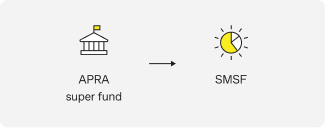
  • Rollovers – moving existing super from another super fund into your SMSF.
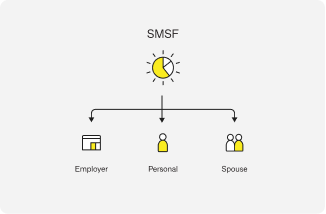
  • Contributions – getting your employer contributions paid into your SMSF account or making personal or spouse contributions.
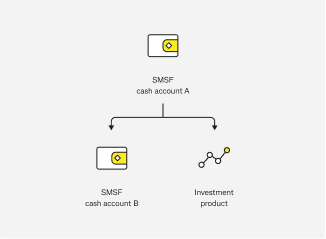
  • Transfers – moving money from one SMSF cash account into another cash account or settling investment transactions.

Rolling over super into your SMSF

What is a rollover?

A rollover is the transfer of existing super from one super fund to another, such as from an APRA-regulated fund into an SMSF.

What needs to be in place before a rollover

Before a rollover can be processed, the SMSF must be correctly set up and visible on ATO systems. This generally includes:

  • Being registered with the ATO as an SMSF and having a status of either Registered or Complying
  • Having an Australian Business Number (ABN) and Tax File Number (TFN)
  • Having a bank account established in the name of the SMSF and recorded with the ATO
  • Having an active Electronic Service Address (ESA) that supports rollovers. Your SMSF administrator or accountant will typically assist with this.

If any of these details are missing or inconsistent, rollover requests could be delayed or rejected.

Important insurance considerations

Rolling over from an APRA-regulated fund may result in the loss of any insurance cover attached to your account, such as life, total and permanent disability or income protection insurance.

Before initiating a rollover, review any existing insurance policies and other benefits. These do not automatically transfer to your SMSF, so you may need to arrange new cover separately or consider a partial rollover to retain the policy.

How a rollover is initiated

When you are prepared, you can request a rollover from your existing fund.

You can start the process through your MyGov account, or by contacting your previous fund directly (partial rollovers cannot be done by MyGov and needs to go through the existing fund to action).

For detailed guidance, visit the Australian Tax Office guidance on rollovers.

Making contributions to your SMSF

Tip: Speak to your SMSF professional before making a contribution to confirm eligibility and amounts that can be appropriately contributed.

What is a contribution?

A contribution is money added to a members superannuation balance. There are three main ways to contribute:

  1. Employer contributions – an employer can pay super contributions directly into an SMSF. They will need the fund’s ABN, bank account details, and ESA to make Super Stream compliant payments.

  2. Personal contributions
- a member can contribute their own money into the SMSF from personal savings or income. Contributions must be paid directly into the SMSF's bank account and clearly identified as a super contribution.

  3. Spouse contributions
- a spouse can contribute to the SMSF on behalf of a member, subject to the relevant rules.


Types of contributions

Contributions are generally classified as either:

  • Concessional contributions (before tax): typically employer contributions and salary sacrifice amounts, generally taxed at 15% and subject to the relevant contribution caps.
  • Non-concessional contributions (after tax): contributions made from after-tax money and have separate caps.

Important

  • Check contribution caps and eligibility: confirm you are eligible to contribute and that the amount stays within the annual contribution caps to avoid excess contributions tax.
  • Record and report the contribution: keep records of all contributions and ensure they are correctly classified and reported in the SMSF’s annual return.

Transferring money into SMSF cash and investment products

What is a cash transfer?

A transfer involves moving money from the SMSF’s cash account to another account or into an investment product. This may occur either within the same financial institution or between different financial institutions.


How transfers typically occur

Cash transfers are generally initiated through a financial institution’s platform, for example via internal transfers or direct debits.

An SMSF cash account may also be used to access investments through a financial institution’s trading platform or investment service. In these cases, the cash account typically acts as the settlement account for investment transactions.

Final tips and resources

  • Keep accurate records of all contributions and rollovers.
  • Ensure your SMSF's bank account is used solely for fund transactions.
  • Running an SMSF involves ongoing legal and administrative responsibilities and is not suitable for everyone. Consider seeking professional advice prior to transferring money into or out of an SMSF. 

Rules and duties of SMSF trustees

Related articles

Distributed by Commonwealth Bank

Things you should know

This article is intended to provide general information of an educational nature only. The information may include general advice but does not take into account your individual objectives, financial situation, needs or tax circumstances, and so you should consider the appropriateness of the advice having regard to your circumstances before acting on it. Where applicable, you should obtain and read the relevant Product Disclosure Statement (PDS) and other important disclosure documents before making a decision about acquiring or continuing to a product. You should consider seeking independent professional financial, tax and/or legal advice before making any decision based on this information.

The information in this article and any opinions, conclusions or recommendations are reasonably held or made, based on the information available at the time of its publication but no representation or warranty, either expressed or implied, is made or provided as to the accuracy, reliability or completeness of any statement made in this article.