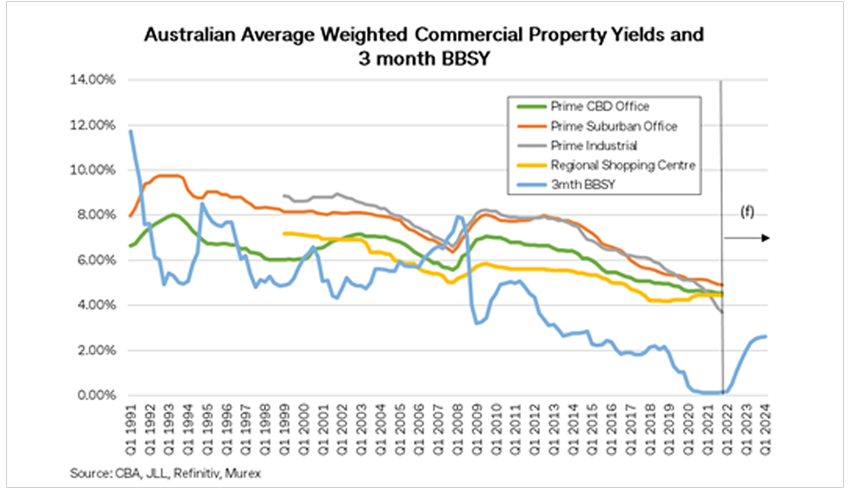


History highlights a positive relationship between the cost of funding debt, investment yields and cap rates applied to commercial property valuations. With interest rate rises factored in for this year, it’s expected to have flow-on effects for commercial property.
Strong investor demand through the pandemic has compressed commercial property yields to record lows, particularly industrial, which in turn has increased values to record highs. For the first time, the Australian average weighted Prime industrial yield (3.71%) has moved clearly below Prime CBD office (4.53%), as at Q4 2021.
However, rising funding costs may impact the market in a number of ways, challenging these high prices and values. First, it may reduce the amount investors can borrow and therefore bid for properties. A reduced number of bidders and the lower competition this creates may in itself be enough to ease trading activity and price growth.
This is likely to be particularly the case for smaller, secondary assets in the first instance, whose buyers tend to rely more on a higher share of debt. Buyers with access to a deeper pool of equity may be able to continue to bid up prices for larger-scale, prime grade assets, creating a division in the market.
Looking back at the six previous cycles from the early 1980s (each of them very different), the rate of yield de-compression has tended to increase, culminating in the GFC, where yields softened at a rate of 120 basis points per annum. Using current projections of the expected increase in the cost of funding as a guide implies cap rates may need to soften from later in 2022.