What are the different types of super funds?

Different types of super funds and how they work

Explore some of the ways that APRA regulated funds and Self-Managed Super Funds differ in structure, flexibility and responsibility.

Different types of super funds and how they work

If you've started exploring your superannuation options, you may have noticed there's more than one way to hold and manage your super. Terms like industry or retail super, member-direct investment options (MDOs), and Self-Managed Super Funds (SMSFs) are often mentioned, but the differences between them aren't always clear at first glance. While all super funds are designed to help people save for retirement, they can vary in:

  • how investment decisions are made 
  • how much control members have
  • the responsibilities placed on members or trustees 

Understanding these differences can help you compare how each option works and how involved you may need to be.

Types of super funds

In Australia, super funds generally fall into two main regulatory categories:

Within APRA-regulated funds, the level of control you have over your investments can vary. Some funds offer standard managed investment options, while others provide member-direct investment options that allow you to select specific assets such as individual shares or exchange traded funds (ETFs).
MySuper (default investment option)

MySuper is the default investment option provided by some APRA-regulated super funds where a member does not make an active choice. It is designed to be simple and standardised, typically offering a single diversified or lifecycle investment approach.

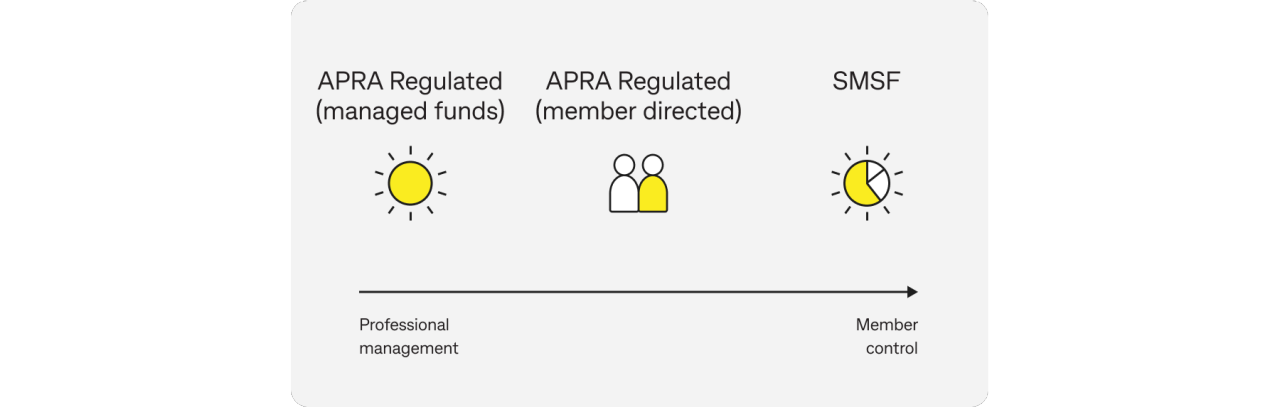
This article explores the different level of investment involvement across the three approaches:

For an overview of super fund types in Australia, visit MoneySmart – Types of Super Funds

Different types of super

Managed investment options in APRA-regulated fund 

How they work

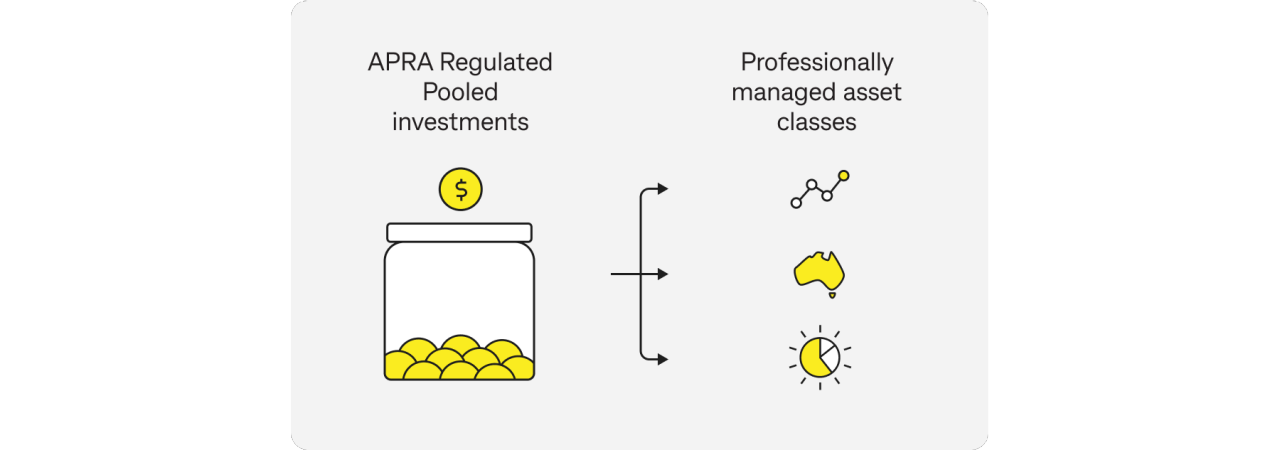
APRA-regulated super funds are among the most common types of super funds in Australia, including industry, retail, public sector and corporate funds. These funds pool money from many members and are overseen by a professional trustee, who is responsible for running the fund and meeting its legal obligations. Investment managers may also be appointed to manage the fund's investments on behalf of members.

APRA-regulated super funds invest members' money through investment options that include a range of different investments managed by professional investment teams. Members generally don't choose individual assets directly. Instead, these funds typically offer a range of options, often with names like growth, balanced or conservative. These options often provide exposure to asset classes such as: 

  • Australian and international shares 
  • Property 
  • Infrastructure 
  • Fixed income 
  • Cash through managed investments 

They give members the ability to invest their super across a wide mix of investments without needing to make individual asset decisions. However, professional investment managers make the individual investment decisions. Members typically do not choose specific shares, managed funds, ETFs or property. Some APRA-regulated super funds also offer member-directed investment options (MDOs), which may allow members to select from a menu of individual investments available through the fund. 

Explore how super investment options work: MoneySmart - Super Investment Options

MIO investment options

Potential benefits and risks

Benefits

APRA‑regulated super funds typically have the following characteristics: 

  • Professional oversight and governance: The fund is overseen by a professional trustee who is responsible for operating the fund and meeting legal and regulatory obligations. 
  • Funds supervised by APRA: Funds are supervised by APRA, which sets prudential standards relating to governance, risk management and financial soundness.  
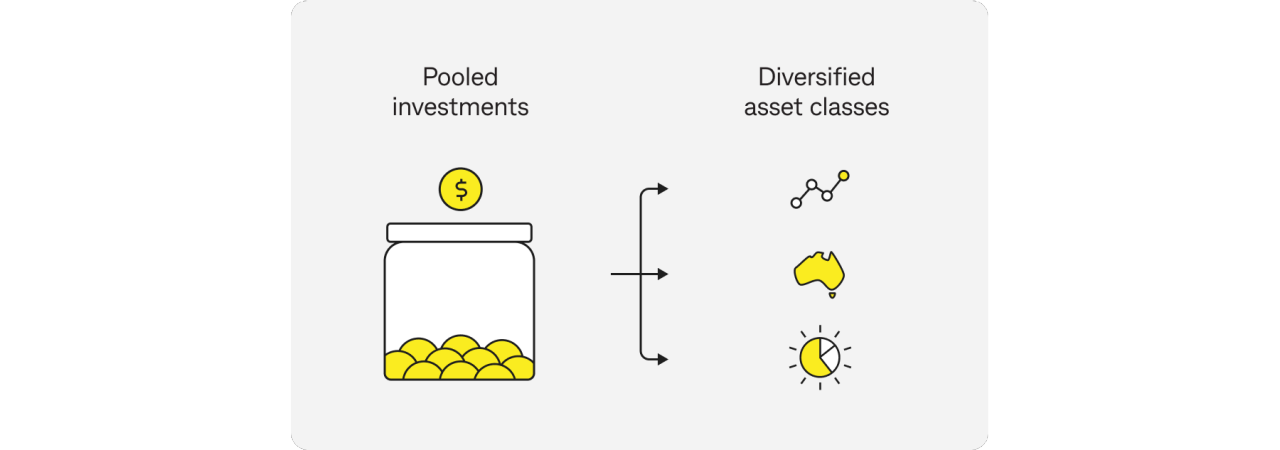
  • Pooled investment structure: Member contributions are pooled and invested collectively, allowing access to a broad range of assets and investment strategies.  
  • Diversified investment options: Funds typically offer a range of pre‑defined investment options that provide exposure across multiple asset classes.  
  • Insurance arrangements within the fund: Group insurance (e.g. life or TPD) may be available through the fund structure, subject to eligibility and fund rules

Risks and considerations

  • Limited direct control and tailoring over investments: Members generally select from available investment options rather than managing individual assets directly.  
  • Fees and costs: Fees (including administration and investment fees) can vary between funds and may impact overall returns over time.  
  • Insurance limitation: Insurance cover provided within super may be subject to eligibility criteria, exclusions, and conditions, and may change over time.  

Want to find out more about different types of super funds? Visit the ATO - Choosing a Super Fund guide

Member direct investment options in APRA-regulated super fund 

How they work

Some APRA-regulated super funds offer what's known as a member-direct investment option. This is an investment feature - not a separate type of super fund - that allows members to select specific individual investments from an approved list, while remaining within their existing APRA-regulated fund. The trustee remains responsible for the fund's compliance and governance.

Depending on the platform, members may be able to invest in:*

  • Australian Shares: Selected companies, usually from the S&P/ASX 300 index. 
  • ETFs & LICs: Selected Exchange Traded Funds (ETFs) and Listed Investment Companies (LICs). 
  • Term Deposits: Fixed-rate term deposits from approved financial institutions. 
  • Cash: An in-house, at-call super cash account 

*The selection of direct investments that are on offer will vary between super funds, as well as the restrictions that apply. Most funds place limits on how much of your super can be held in any particular security. 

MDO investment options

Potential benefits and risks

Benefits

This option provides increased investment choice within the constraints of an APRA regulated super fund, allowing members to take a more active role in investment decisions.  Potential benefits can include: 

  • Increased choice and flexibility: Members can select specific investments from an approved list rather than relying solely on pre-defined investment options.  
  • Investment choices: Access to a range of assets such as, selected ASX shares, ETFS or term deposits, depending on the fund/funds approved list.   
  • Retained fund structure: The super fund continues to manage administration and compliance responsibilities  
  • Access to online platforms for monitoring and managing investments 

Risks and considerations

  • Investment decision responsibility: Members make choices about specific investments (within the option), which means outcomes depend on individual decisions rather than solely on the fund's default strategy. 
  • Fees and transaction costs: Additional costs may apply, such as brokerage, platform or administration fees specific to the member‑directed option. 
  • Limited investment range: Available investments are typically restricted to a defined menu (e.g. selected shares, ETFs, term deposits), which may not cover all asset classes or strategies.

Self-Managed Super Funds (SMSF) 

How they work

An SMSF is a private super fund managed by its trustees. Trustees are responsible for investment decisions and for making sure the fund complies with super and tax laws. SMSFs can offer a high level of control, but that control comes with significant legal, administrative and financial responsibilities.

SMSFs offer flexibility, allowing members to tailor their investment strategy to suit their retirement goals. As a trustee, you can invest in a wide range of assets, such as:

  • Australian and international listed shares 
  • ETFs and managed funds 
  • Cash, term deposits and bonds 
  • Property 
  • Collectables and personal-use assets (with strict rules)

Trustees are responsible for making sure each investment: 

  • complies with super law
  • aligns with the fund's investment strategy
  • is managed in the best financial interests of members
  • supports the purpose of saving for retirement, rather than providing personal benefits

Trustees also need to manage issues such as risk, liquidity and diversification.  

SMSF investment options

Potential benefits and risks

Benefits

Some people are drawn to SMSFs because they want to be directly involved in every aspect of managing their retirement savings. This level of involvement can suit certain individuals - but it also comes with significant legal, administrative, and financial responsibilities that should be carefully considered.

  • Direct control over investments: Trustees make decisions on how the fund is invested, with access to a wide range of assets, such as shares, ETFs, managed funds, cash, bonds, property, and certain collectables (subject to rules). 
  • Tax strategy opportunities: SMSFs can provide opportunities to implement tax-effective investment strategies. However, these strategies depend on individual circumstances and require careful planning with a qualified tax adviser. 
  • Pooling resources: Members can combine super balances within one fund, which may increase available capital and support shared investment management. 

Risks and considerations

SMSFs involve greater responsibility and ongoing obligations for trustees.

  • Legal responsibility: Trustees are responsible for things like strategic decision-making, administration, and making sure the fund complies with super and tax laws, even when using professional support. For the most up to date responsibilities refer to the ATO website
  • Time commitment: Managing an SMSF can require a significant and ongoing time investment, with trustees responsible for overseeing compliance, administration, and strategic decision-making.
  • Management costs can add up: SMSFs can be expensive to set up and maintain. Common costs could include accounting, administration, audit, advisory services, and insurance premiums. These costs can add up over time, making it important for trustees to assess whether their fund size justifies these expenses. 
  • There is no safety net: Unlike other super funds, SMSFs may not be covered by compensation schemes in cases of fraud or theft. 
  • Life events can be complex: Managing deaths, or relationship breakdowns within an SMSF can be complex. Similarly, leaving an SMSF is nowhere near as simple as leaving a public super fund. It's important to know when you need help and to make sure you get it, as well as having an exit strategy and succession in place.  

Find out more about SMSF risks: MoneySmart - Self-Managed Super Fund 

Feature
APRA-regulated (managed options)
APRA-regulated (member-direct options)
SMSF
Who manages the fund
Professional trustee
Members as trustees
Investment control
Select from pre-set options
Choose from an approval list and managed options
Trustees make investment decisions within legal requirements
Investment approach
Diversified pooled investments
Mix of managed options and direct investments (e.g. shares, ETFs)
Broad range of assets, subject to super law
Level of involvement
Generally lower
Moderate
Higher
Responsibility for compliance
Fund trustee
Trustee (member responsible for investment choices within option)
SMSF trustees
Costs
Fund-level fees (may benefit from scale)
Additional fees may apply (e.g. brokerage, platform)
All costs borne by fund (e.g. admin, audit, advice)
Insurance
Often available within the fund (terms apply)
Must be arranged separately and / or retained in the APRA fund
Administration
Managed by the fund
Managed by the fund
Managed by trustees, often with external support
Flexibility
Limited to available options
Broader, but within defined investment menu
High, within regulatory constraints

Before choosing a super structure 

The right super structure depends on how much control you want, how involved you're prepared to be and the responsibilities you're comfortable taking on. 

Before making changes, consider: 

  • your retirement goals  
  • your investment knowledge and confidence  
  • the fees and costs involved  
  • the time you can commit  
  • whether you need professional advice


Summary

Each superannuation structure offers a different balance of control, responsibility and involvement. Understanding how these structures work can help you engage more confidently with your superannuation. Because superannuation decisions are complex and have long-term implications for your retirement, consider speaking with a licensed financial adviser before making any changes to your super arrangements. A financial adviser can assess your individual circumstances and help you understand which structure, if any, is right for you.

Is an SMSF right for you?

Related articles

Distributed by Commonwealth Bank

Things you should know

This article is intended to provide general information of an educational nature only. The information may include general advice but does not take into account your individual objectives, financial situation, needs or tax circumstances, and so you should consider the appropriateness of the advice having regard to your circumstances before acting on it. Where applicable, you should obtain and read the relevant Product Disclosure Statement (PDS) and other important disclosure documents before making a decision about acquiring or continuing to hold a product. You should consider seeking independent professional financial, tax and/or legal advice before making any decision based on this information.

The above information is not tax advice. Taxation laws are complex and subject to change. Commonwealth Bank does not provide tax (financial) advice under the Tax Agent Services Act 2009 (Cth). You should consider seeking independent tax advice from a registered tax agent, accountant or adviser before you make any decisions based on this information.

The information in this article and any opinions, conclusions or recommendations are reasonably held or made, based on the information available at the time of its publication but no representation or warranty, either expressed or implied, is made or provided as to the accuracy, reliability or completeness of any statement made in this article.

Past performance is no guarantee of future performance. Investing carries risk.