


Related

How does credit card interest work?

Knowing how your credit card interest is calculated and when it's charged can help you manage your repayements and avoid paying unnecessary interest.

Learn more

Smart credit strategies

For CommBank personal finance expert Jess Irvine, when credit cards are used wisely, they can help you pocket some handy savings.

Learn more

  • Most CommBank credit cards offer an interest-free period on purchases of up to ~44–55 days — meaning you won’t be charged interest on purchases as long as you pay your closing balance in full by the due date each month.
  • If you don’t pay the full closing balance by the due date (even if you make the minimum payment), you’ll lose the interest-free benefit and start accruing interest on your outstanding balance.
  • To maximise the interest-free window, pay off your balance in full monthly, consider planning larger purchases early in the cycle, and use reminders or AutoPay to avoid missing your due date.

Most credit cards offer an interest-free period on purchases up to a certain number of days. This period is the maximum amount of time between you making a purchase and then being charged interest – as long as you don’t already owe money on your credit card.

Being able to buy now and then pay later is one of the biggest advantages of a credit card. So how can you make the most of the interest-free period?

What's interest?

Interest is the cost associated with borrowing money through your credit card account, and is expressed as an annual percentage rate. You can find out your interest rates and charges on your CommBank monthly statement. The purchase interest rate is the one most commonly advertised by lenders, and refers to the rate charged on purchases made with a credit card if an interest-free period doesn’t apply.

What's an interest-free period and how is it calculated?

An interest-free period is a period of time when no interest is charged on a new purchase, and may automatically apply when you open a new credit card account. It will continue to apply as long as you pay your closing balance in full by the due date each and every month.

Most credit cards offer an interest-free period of up to a certain amount of days. This number is the maximum number of days you won’t be charged interest, and depends on when you make your purchase within the statement cycle.

Read more about how credit card interest is calculated.

How it works

Most CommBank credit cards offer an interest-free period on purchases of up to 44 or up to 55 days. Excludes our Business Low Rate credit card which doesn’t have an interest free period. 

Each statement period runs for about 30 days. Then, it’s 14 days for Awards credit cards and 25 days for non-Awards credit cards from when your statement period finishes to the payment due date. If you’re eligible for an interest-free period, the minimum number of interest-free days you’ll have is 14 or 25 days depending on your credit card product.

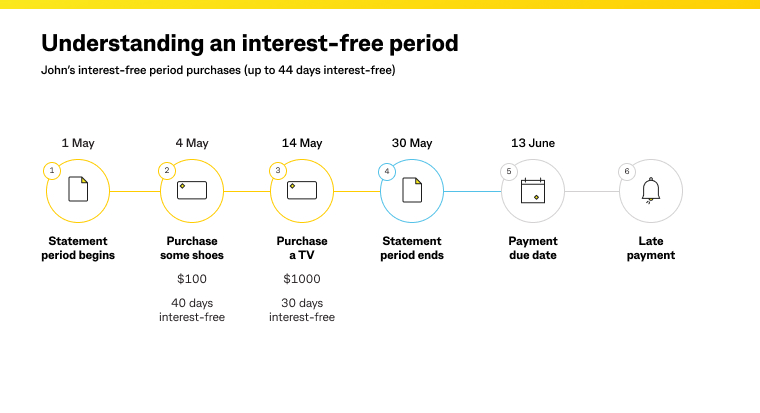
Understanding an  interest-free period graph

In the above example, John’s interest-free* period on purchases is up to 44 days.

1. 4 days after John’s statement period begun on May 1, John purchases some shoes for $100. He has 40 days interest-free on this purchase.

2. On May 14, John purchases a TV for $1,000. He has 30 days interest-free on this purchase.

3. On May 30, John’s statement period ends and he receives his statement. John now has 14 days to pay off his closing balance in full which is made up of his purchases during the period. In this case, his closing balance is $1,100.

4. June 13 is John’s payment due date. To avoid paying any interest on the purchases he’s made, John must pay his closing balance in full by the payment due date. If he doesn’t pay in full, he’ll lose his interest-free period on purchases and interest will be charged on his unpaid balance (including any purchases made since his last statement period ended) from after the payment due date.

John will receive a late payment fee if he doesn’t pay at least the minimum payment shown on his statement by the due date each month.

Interest-free Low Fee Credit Card

Here’s our simplest credit card yet. Say goodbye to interest, late fees and hidden charges – Just a $10 monthly fee.


Learn more

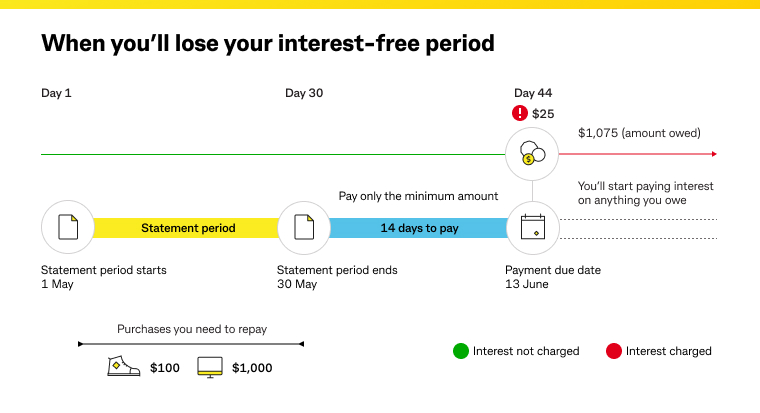
What happens if you don’t repay your closing balance in full?

If you do not pay your closing balance in full or just make a minimum repayment, you will lose your interest-free period and interest will be charged on your unpaid balance from after the due date until you repay in full.

losing your interest-free period graph

How to avoid paying interest

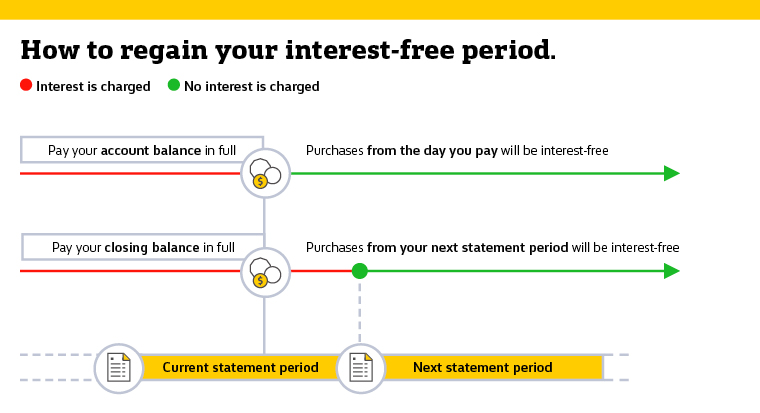
If you have been paying interest on purchases, you can regain your interest-free* period by:

  • Paying your account balance in full to get interest-free on all purchases from that day.1 Your account balance is made up of everything you owe up until today, including any purchases you’ve made since your last statement.2
  • Paying your closing balance in full by the due date shown on your statement to get interest-free on new purchases in your next statement period. Your closing balance is the amount you owe from your last statement period. 

Remember, the sooner you pay off everything you owe, the less interest you’ll need to pay – you don’t need to wait until the due date.

How to regain your interest-free period graph

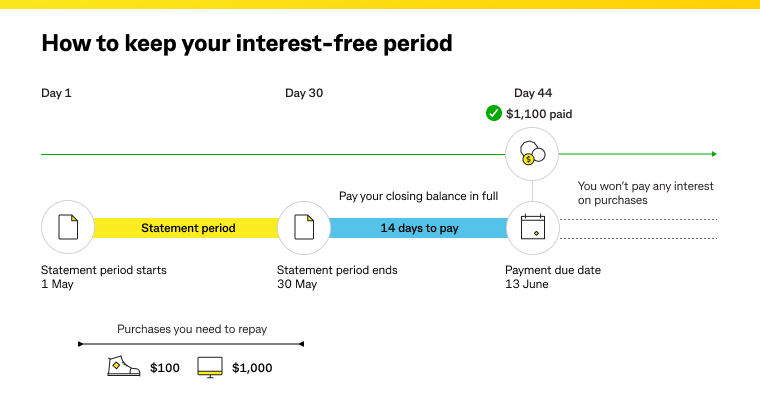
How to take advantage of the interest-free* period

  • Pay your closing balance off in full each month
  • Set reminders to make sure you pay your balance in time or use AutoPay
  • Try to plan your spending so you make any bigger purchases at the start of the statement period to give yourself more time to repay.
How to keep your interest-free period graph

Choosing the right CommBank credit card

Choosing the right card depends on how you use it. Whether you're looking for a low-fee card for simple everyday purchases or a reward card, understanding how they work can help you make a confident choice.

Check out all our current credit card offers here

Compare our latest credit card offers to find the offer that best suits your needs. 

Find out more

Latest stories from Brighter Magazine

Brighter Magazine

Gippsland’s natural wonders and the locals who bring it to life

Meet the locals who are redefining life in Gippsland, from nature retreats and sustainable farms to vibrant coastal communities and discover why th...
Brighter Magazine

The power of long‑term investing: Lessons from three everyday investors

Learn how three Australian investors grew their wealth through simple, consistent strategies. From compounding and diversification, to investing in...
The Brighter Side

How to set a travel budget with a partner

Want to travel with a partner but don’t know how to manage your budgets? Learn how Logan and Jordy managed to save smart for their holiday.
Brighter Magazine

The easy money move hiding in your insurance policy

When was the last time you looked at your car or home insurance? If you’re thinking, “Honestly... not for a while,” you’re in good company.

Manitoba, Canada: A place where every moment feels epic

[Sponsored] From polar bears to the northern lights, adventures in Manitoba, Canada feel larger than life. Find experiences that will stay with you...

A smarter way to bring AI into your business

Discover how experts recommend businesses start using AI— from choosing the right tools to building skills and boosting efficiency without overwhel...

Things you should know

* The examples above are for illustrative purposes only. The examples assume that you have previously paid your closing balance in full by the due date each month and are eligible for an interest-free period on purchases, and you can continue to do so to maintain your interest-free period. The examples also assumes only purchases have been made and no balance transfers, SurePay instalment plans or cash advance transactions apply.

1 Please note: sometimes we don’t receive payments in time to process them the same day as you make them, for instance when you transfer from another bank, which may affect this.

2 Your account balance does not include any pending transactions.

This article is intended to provide general information of an educational nature only. It does not have regard to the financial situation or needs of any reader and must not be relied upon as financial product advice.